
clean meat


No poverty
no war
barter
#FridaysForFuture


happy animals
happy people
happy earth
clean environment
- mindful people
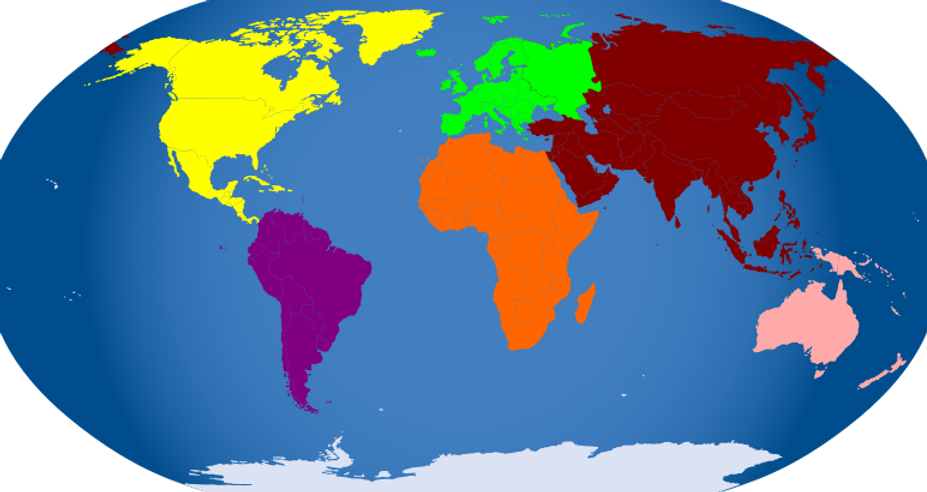
The seven continents
The world has seven continents. They are Africa, Antarctica, Asia, Australia/Oceania, Europe, North America, and South America. However, depending on where you live, you may have learned that there are five, six, or even four continents. This is because there is no official criteria for determining continents. While the position of landmasses on continental crust may be used to determine continents, geopolitical factors also affect their delineation. Above is an overview of the world's continent using the most popular classification system, the seven continent method.
Geologically, the continents largely correspond to areas of continental crust that are found on the continental plates. However, some areas of continental crust are regions covered with water not usually included in the list of continents. Zealandia is one such area (see submerged continents below). Islands are frequently grouped with a neighbouring continent to divide all the world's land into geopolitical regions. Under this scheme, most of the island countries and territories in the Pacific Ocean are grouped together with the continent of Australia to form a geopolitical region called Oceania.
Continent
Africa
Antarctica
Asia
Australia/Oceania
Europe
North America
South America
Area (km²)
30,370,00
14,000,000
44,579,000
8,600,000
10,180,000
24,709,000
17,840,000
Area (mi²)
11,730,000
5,400,000
17,212,000
3,300,000
3.930.000
9,540,000
6,890,000
Percent tot landmass
20.4%
9.2%
29.5%
5.9%
6.8%
16.5%
12.0%
Population
1,287,920,000
4,490
4,545,133,000
41,261,000
742,648,000
587,615,000
428,240,000
Percent total pop
16.9%
0.0%
59.5%
0.5%
9.7%
7.7%
5.6%
Most populous city
Lagos, Nigeria
McMurdo Station
Shanghai, China
Sydney, Australia
Moscow. Russia
Mexico City, Mexico
São Paulo, Brazil
Note.
1
2
3
4
5
6
-
Includes the Sinai Peninsula in Egypt.
-
Population is non-permanent and varies.
-
Includes East Thrace (Turkey) and Western New Guinea (Indonesia), excludes Russia and Egypt.
-
Includes Asiatic Russia, excludes Turkey.
-
Includes Central America and the Caribbean.
-
Excludes Indonesia.
Certain parts of continents are recognized as subcontinents, especially the large peninsulas separated from the main continental landmass by geographical features. The most notable examples are the Indian subcontinent and the Arabian Peninsula. The Southern Cone of South America and Alaskan peninsula of North America are other examples.
In many of these cases, the "subcontinents" concerned are on different tectonic plates from the rest of the continent, providing a geological justification for the terminology. Greenland, generally reckoned as the world's largest island on the northeastern periphery of the North American Plate, is sometimes referred to as a subcontinent. This is a significant departure from the more conventional view of a subcontinent as comprising a very large peninsula on the fringe of a continent.
Where the Americas are viewed as a single continent (America), it is divided into two subcontinents (North America and South America). When Eurasia is regarded as a single continent, Europe is treated as a subcontinent - Source
Flags of the Continents
Flags of the Continents - the seven unions of the earth. Today there are no approved flags per continent. Everyone can therefore make suggestions on how these flags should look like. We are happy to see suggestions from our members.