
clean meat


No poverty
no war
barter
#FridaysForFuture


happy animals
happy people
happy earth
clean environment
- mindful people
Barter - a new ecological trading system
In trade, barter is a system of exchange where participants in a transaction directly exchange goods or services for other goods or services without using a medium of exchange, such as money.
Economists distinguish barter from gift economies in many ways; barter, for example, features immediate reciprocal exchange, not delayed in time. Barter usually takes place on a bilateral basis, but may be multilateral (i.e., mediated through a trade exchange).
In most developed countries, barter usually only exists parallel to monetary systems to a very limited extent. Market actors use barter as a replacement for money as the method of exchange in times of monetary crisis, such as when currency becomes unstable (e.g., hyperinflation or a deflationary spiral) or simply unavailable for conducting commerce. Source

We no longer have the capacity to let economic factors control the production of food and ingredients,
the main production must be within as close geographic area as possible and within a country or continent.
We must stop bargaining and compete through the trade agreements. Food must never be an economic negotiation product.
Barter exchange
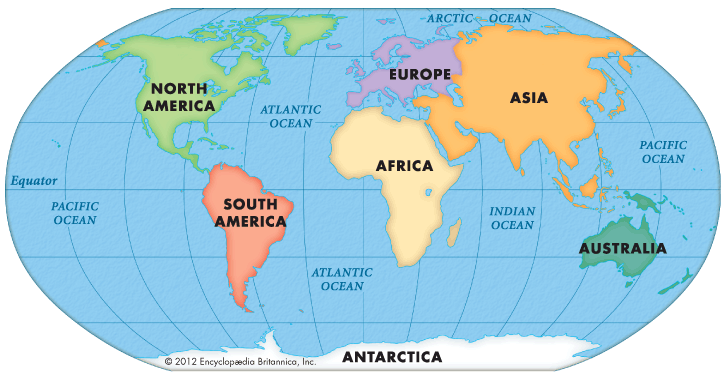
Minerals and crops that are missing within a continent are what will be exchanged according to the Barter model. These resources shall not be seen as a property of a country or continent, but as common resources to be exchange and managed for the future.
Countries and continents no longer need to produce meat but instead concentrate on cultivation for human consumption and cultivation for biodiversity ie polyculture cultivating. As the need for crops decreases, we want to introduce a total ban on GMO crops and all use of pesticides.
Shipping (ship) between continents must use origin national flag and have tracible oil/fuil code.


Biodiversity of insects is threatened worldwide.

The United Nations Environment Programme (UN Environment)
“Growing material use is driven by expanding populations, consumption trends in mainly developed economies and the transformation of developing economies,” the report says. “Demand for resources has shifted from renewable to non-renewable resources, reflecting the global trend away from traditional towards modern technologies, and from agriculture-based economies to urban and industrial economies.
“This creates new waste flows – thereby increasing emissions and pollution. For example, data show that the steep increases in demand for ores, like iron, have contributed to sharp rises in greenhouse gas emissions, acidification, aquatic eco-toxicity and emissions of smog-forming substances.”
There are no price tag on earth's climate, nature or resources